


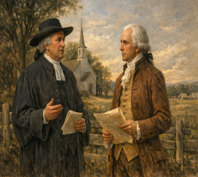
“Why American Baptist History Matters”
By Rev. Dr. Carla A. Romarate-Knipel
“For you have been called to live in freedom, my brothers and sisters. But don’t use your freedom to satisfy your sinful nature. Instead, use your freedom to serve one another in love.”
-
-
-
-
-
-
-
-
-
-
- Galatians 5:13, NLT
-
-
-
-
-
-
-
-
-
“The Lord compelled Baptists to ‘stand fast in the liberty wherewith he has made us free…’
– Isaac Backus, prominent Baptist leader from Connecticut, 1776 (The Story of Baptists in the United States, by Pamela R. Durso and Keith E. Durso, pp. 61-62)
“History Matters” was the slogan that the Board of Managers adopted when I was serving as secretary of the American Baptist Historical Society over 15 years ago. One well-known saying that reinforces this message is, “Those who don’t remember history is bound to repeat its mistakes.” I would venture to say however, that it’s not just mistakes that we are trying to avoid repeating but lessons remembered to help us move forward to a more hopeful future.
This month of July, it is my hope that in celebrating our nation’s 250th foundation anniversary, the contributions of Baptists in the birthing and growth of the United States of America be highlighted and serve as lessons that we can learn from in our ongoing struggle to live out our faith and calling as Jesus’ disciples and church in these challenging and turbulent times.
I am writing this message at a time when America is hosting the World Cup along with Canada and Mexico. Running into Scottish fans in their kilts and Brazilians in their yellow and green t-shirts at the 30th Street Station in Philadelphia has ignited my love for soccer but even more so, with everything American! As a naturalized American my love for my adopted country has become like a flame fanned by the presence of friendly guests from all over the world who are excited to discover and savor what America has to offer. I have never been more proud to be an American and Baptist! I wish Pastor Dave were here to see me embrace my American and Baptist heritage with great joy! But even with his physical absence I believe he and all those in the “great cloud of witnesses” who have gone before us, are cheering us on, encouraging us to remember what has already been accomplished and the ongoing work that has been entrusted to us. What then can we learn from our own Baptist history in times such as these? Let’s go down memory lane and find out.
In 1776, Isaac Backus, a prominent Baptist leader from Connecticut, with two of his colleagues from New York and Rhode Island started an organization called the Warren Association to promote religious liberty. The colonial civil authorities were imposing a religious tax to support the religious establishment for the good of civil society. Backus and his Baptist colleagues resisted this even with the threat of imprisonment and having their homes and property taken from them.
It is important to note that even with the diverse Baptist traditions within the Baptist family, there are several things that we have in common that contributed to the shaping of America.
The American Baptist Historical Society’s newsletter Primary Source, vol. 24, no. 2, published an article titled “What the History of Baptists Can Teach Us,” written by Dr. Jeff Waldrop. Dr. Waldrop presented four things that Baptists in the 17th century have in common with Baptists today. They are:
- “Many Baptists were refugees. – At the end of the 17th century Baptist immigrants arrived in New England as part of the English/Welsh migration. Prior to this, Congregationalists had already arrived, and some became Baptists, such as Roger Williams and John Clarke, who became refugees seeking religious freedom in Rhode Island. Many of these Baptist refugees were persecuted, imprisoned and banished because of their religious beliefs.”
- “Baptists were persecuted for being different. – Baptists were penalized for simply practicing a faith that contradicted the theological norms of their fellow colonists. In 1651, Baptists Obadiah Holmes, John Clarke, and John Crandall were arrested by Congregationalist authorities in Lynn Massachusetts. Akk three were flogged… Between 1768-1777, twenty-nine Separate Baptists in Virginia would be imprisoned, whipped, or executed for preaching without a license.”
- “Baptists were eventually accepted. – While freedom from compulsory ecclesiastical taxation would not be realized throughout the new country until 1833, general persecution of Baptists ended during the Revolutionary War era. With the passage of the Toleration Act of 1688 in England, nonconformists had gained freedom to worship without fear of reprisals, but Baptists in the American colonies continued to endure discrimination, and appealed to both Baptists and civil authorities in England for help… Baptist leaders such as Isaac Backus negotiated a truce with Congregational authorities and organized Baptists in New England for participation in the war effort. After the Revolutionary War, Baptists spread rapidly throughout the American states.
- “Baptists exerted positive influence.” – There is a long list of accomplishments that Baptists in America have achieved in missions, social work, prison ministry, education, and multicultural ministry. One example is, “After the Civil War, Northern Baptists sent teachers, church planters, and other professionals to the southern states for the purpose of assisting African Americans with education, job skills and church organization. In the decades leading to and after World War II, American Baptists provided educators, missionaries and church planters to Chinese and Japanese communities on the west coast. In both instances, Northern/American Baptists offered social and spiritual service when other Christian groups failed to do so.
Dr. Waldrop challenges us to reflect on his insights: “In our context, many immigrant Christians, Baptists included, are being depicted as criminals on the national stage. Actions taken against immigrant communities closely parallel the persecution suffered by Baptists in the early American colonies. Many immigrant pastors are preaching a message of hope amidst suffering as did the Baptists. Also, like the Baptists during the Revolutionary War, pastors and immigrant community leaders urge a message of resilience, political action and patience. A significant part of the American cultural fabric, immigrants are also responsible for church growth in the U.S. History shows us that as the next generation of Baptists emerges from immigrant communities, there is little doubt that they will continue to impact American life. By doing so, they will further add to an already stellar Baptist tradition.”
As I reflect on Dr. Waldrop’s article and insights I am encouraged to pray and envision a ministry to those who shop at Jeanette’s closet. Many have come to America as immigrants fleeing from violent groups in their countries of origin, seeking a better life for their families, especially their children. Just like our Baptist spiritual forebears, may we be inspired to have the courage, compassion and commitment to uphold freedom as a gift from God through Christ expressed in serving those who come to Jeanette’s closet on Tuesdays or any other day.
May we celebrate our 250th anniversary as a nation with gratitude to God who gave us the gift of freedom, remember all those who lived and gave their lives so that freedom will continue to ring throughout this land. And may we renew our commitment to keep the flame of freedom alive in our hearts, and let that fuel our love to serve God and our neighbors.
Moving forward let us pray and make time these summer months to rest and slow down, listen to God and seek God’s leading for us come September and the rest of the year.
Happy 250th Foundation Anniversary of the Founding of our beloved country, the United States of America!
Praise God for the gift of our country, our Baptist heritage and the continuing call of Jesus for us to follow him and his example of compassionate and caring service to our community and preaching the Good news of God’s love and grace.
Have a safe and restful summer!
Yours in Christ,
Pastor Carla

